

Power of Plants. Anticancer cytotoxic effects of Delonix regia (Royal Poinciana Flame Tree) extracts
Exploring the Potential of Royal Poinciana (Delonix regia) in Cancer Research
As a flower essence hunter and oncology focused clinical acupuncturist student I am fascinated with the potential healing properties of Delonix regia.
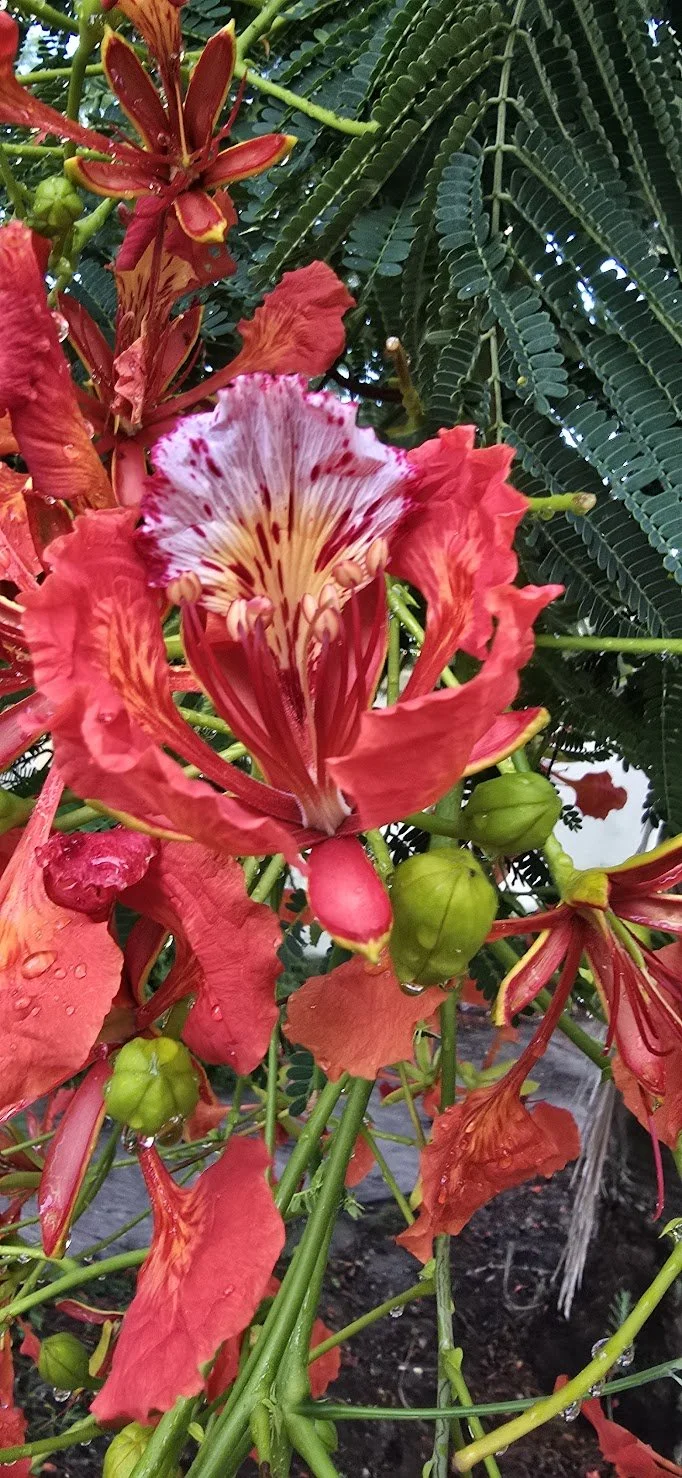
The Royal Poinciana, also known as the Flame Tree or Flamboyant (Delonix regia), is famous worldwide for its spectacular display of bright red-orange flowers. Beyond its ornamental beauty, this tropical tree has a long history in traditional medicine for issues like inflammation, digestive problems, and respiratory complaints. In recent years, scientists have turned their attention to another possible property: anticancer activity observed in laboratory studies.
Several research teams have tested extracts from different parts of the plant against human cancer cell lines. Flower extracts have shown particular promise. In one study, ethanolic extracts and flavonoid-rich fractions of the flowers demonstrated cytotoxicity against human liver cancer cells (HepG2). A hydro-ethanolic flower extract also exhibited cytotoxic effects across multiple cancer cell lines in vitro.
More recent work highlighted a flavonoid-rich flower extract that inhibited the growth of breast (MCF-7), cervical (HeLa), oral (KB), colon (HT-29), and leukemia (P-388) cells in a dose-dependent manner, while showing relatively low toxicity to certain normal cell lines. Key compounds such as rutin, isoquercitrin, and myricetin were identified as contributors.
Leaf extracts have been examined as well. n-Hexane and acetone extracts displayed inhibitory activity against cervical cancer (HeLa) cells, with the n-hexane extract performing more strongly in one evaluation, though effects on prostate cancer cells were limited.
These findings are encouraging from a scientific perspective and point to the presence of bioactive compounds, flavonoids, sterols, and phenolic acids that may help explain the observed effects. However, it is essential to emphasize that all of this research remains at the laboratory (in vitro) stage. There is currently no clinical evidence supporting the use of Royal Poinciana extracts as a cancer treatment, and the plant is not an approved therapy for any form of cancer.
As with many plants studied for medicinal potential, further investigation, including animal studies and carefully controlled human trials would be needed to determine whether these laboratory observations translate into real therapeutic value.
Encouragingly though, there are a few key documented scientific studies (primarily in vitro) reporting cytotoxic or antiproliferative activity of Delonix regia extracts against cancer cell lines. These support the laboratory observations of potential anticancer effects mentioned earlier. Note that these are preclinical findings only no clinical evidence or approved medical use for cancer treatment exists.
Flower Extracts
El-Sayed AM, Ezzat SM, Salama MM, Sleem AA. Hepatoprotective and cytotoxic activities of Delonix regia flower extracts. Pharmacognosy Journal. 2011;3(19):49–56.
Ethanolic extract, non-polar fraction, and flavonoid-rich fraction showed cytotoxicity against the human liver cancer cell line HepG2. Isolated sterols (including β-sitosterol and stigmasterol) contributed to the activity.Pusapati MR, Jonnalagadda T, Kola PK, Yarlagadda AC, Guntuku G. In vitro cytotoxic activity of hydro ethanolic extract of Delonix regia (Bojer ex. Hook.) flowers on cancer cell lines. British Journal of Pharmaceutical Research (or Journal of Pharmaceutical Research International). 2014;4(4):443–452.
Hydro-ethanolic flower extract demonstrated cytotoxic properties against multiple human cancer cell lines via MTT assay.Khongkaew P, Wattanaarsakit P, Papadopoulos KI, Chaemsawang W. Antioxidant Effects and in vitro Cytotoxicity on Human Cancer Cell Lines of Flavonoid-Rich Flamboyant (Delonix regia (Bojer) Raf.) Flower Extract. Current Pharmaceutical Biotechnology. 2021;22(13):1821–1831. DOI: 10.2174/1389201021666201029154746.
Flavonoid-rich flower extract showed dose-dependent cytotoxicity against human breast adenocarcinoma (MCF-7), cervical carcinoma (HeLa), oral cavity carcinoma (KB), colon carcinoma (HT-29), and murine leukemia (P-388) cell lines, with relatively low toxicity to certain normal cell lines. Key flavonoids identified included rutin, isoquercitrin, and myricetin.
Leaf Extracts
Sheikh SA, Ahmed A, Asadullah, Nawaz S. Anticancer Activity of n-Hexane and Acetone Leaf Extracts from Delonix regia (Gul Mohar) on HeLa (Cervical) and Prostate Cell Lines. Journal of Bahria University Medical and Dental College. 2025;15(1):03–07. DOI: 10.51985/JBUMDC2024426.
n-Hexane leaf extract showed higher inhibition (~55.8%) against HeLa (cervical) cells than the acetone extract; both had limited activity against prostate cancer cells. Cytotoxicity was also observed on normal fibroblast (BJ) cells. Activity was lower than the standard drug doxorubicin.
Additional Related Findings
Other studies have reported activity of bark or flower extracts against breast cancer (MCF-7) cells and general cytotoxic potential (sometimes using brine shrimp lethality as a preliminary screen). Reviews synthesizing these results often attribute effects to flavonoids, phenolic acids, sterols (e.g., β-sitosterol, lupeol), and related compounds that may promote apoptosis or inhibit proliferation in cell culture.
Important caveats: These are almost exclusively in vitro (cell-line) results. There is a lack of robust in vivo (animal) data or human clinical trials confirming efficacy or safety for cancer treatment. Extracts are not standardized medicines, and the plant has no established role in oncology. Always consult qualified medical professionals for cancer-related care.
While laboratory studies on plants like the Royal Poinciana (Delonix regia) have revealed promising cytotoxic effects against certain cancer cell lines, they also serve as a reminder of a far broader opportunity: countless ethnobotanicals used in traditional medicine systems around the world remain underexplored by modern science. Indigenous and folk knowledge has already guided the discovery of valuable compounds, and many other species, still poorly studied or even undocumented in formal literature may contain molecules capable of selective activity against tumor cells. Continued respectful collaboration with traditional practitioners, combined with rigorous pharmacological research, offers genuine potential to uncover new leads that could one day contribute to improved cancer therapies. Protecting biodiversity and cultural knowledge is therefore not only an ethical imperative but a practical step toward expanding the toolkit against this complex disease.
Contact me to discuss how plants can truly help support a quality of life during cancer treatment.