

Flower Essence Hunting, Buttonbush and Cancer Support
Buttonbush Flowers and the Quiet Power of Their Essence: Supportive Companionship for the Cancer Journey
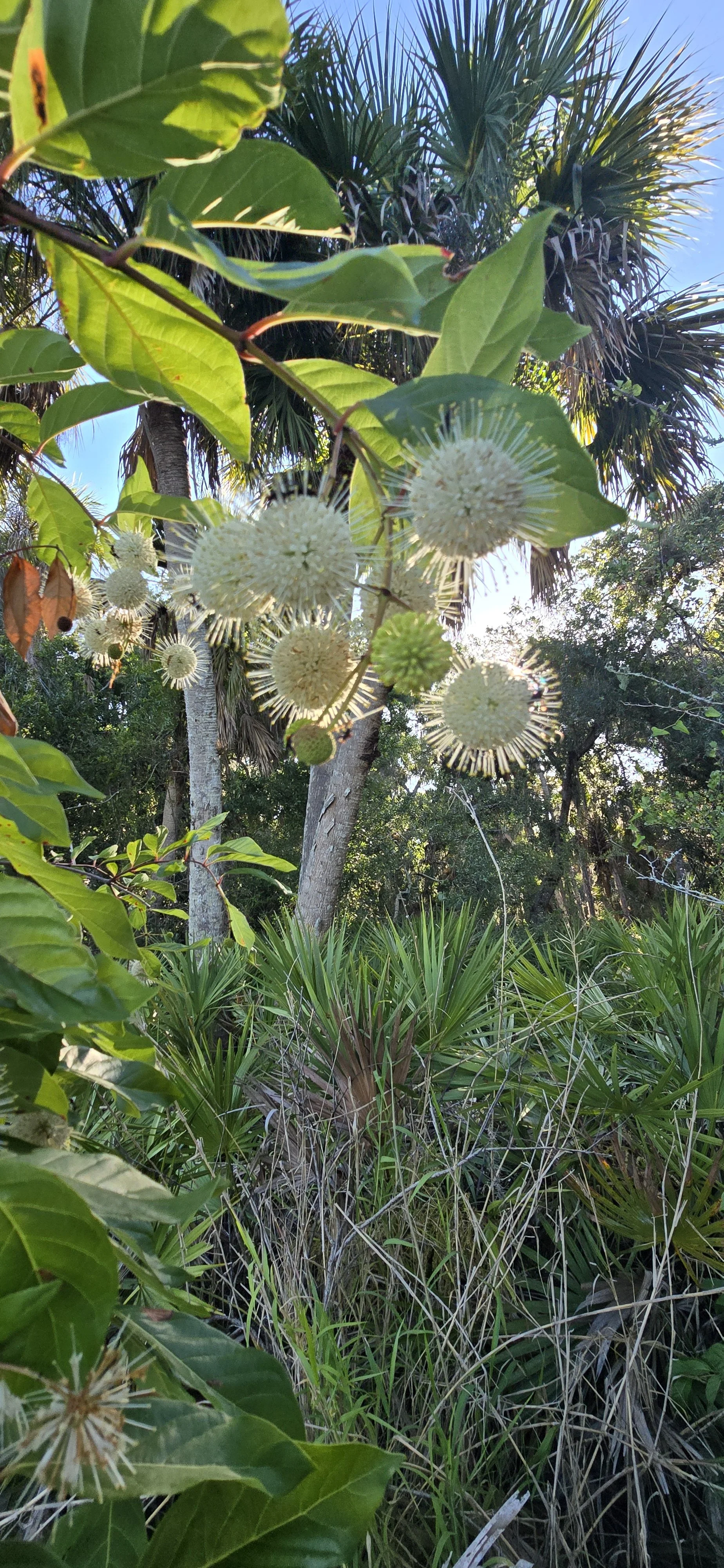
In the soft light of midsummer wetlands, buttonbush (Cephalanthus occidentalis) reveals one of nature’s most distinctive blooms. Clusters of tiny, creamy-white flowers form perfect spheres—soft, fragrant “honey balls” that look like miniature Sputniks or celestial orbs suspended on glossy green stems. Native to eastern North America, this shrub thrives at the water’s edge, where land and liquid meet. Its presence feels both grounded and luminous, a living emblem of balance between the solid and the fluid. The flowers pictured here are Myakka River residents!
Flower essences capture the vibrational imprint of a plant’s flowering state rather than its physical chemistry. Prepared by floating blossoms in pure water under sunlight (or sometimes moonlight), the resulting essence is preserved in a brandy-water solution and taken in tiny drops. These remedies do not act as pharmaceuticals. They work on the subtle emotional and energetic levels, gently encouraging the shifts that allow a person to meet life’s challenges with greater clarity, resilience, and inner harmony.
The Signature of Buttonbush
The spherical form of the buttonbush flower is its clearest teaching. Every individual floret radiates outward from a shared center, creating a unified whole. In the language of flower essence work, this geometry often speaks to integration—bringing fragmented parts of the self back into coherent relationship. The plant’s wetland habitat further suggests an affinity for emotional fluidity: the capacity to move feelings rather than become stuck in them, and to remain rooted even when the ground feels uncertain.
Traditional Native American uses of the plant (primarily the bark and roots as teas or poultices for fevers, digestive issues, and eye complaints) hint at a broader reputation for clearing and tonifying. While those applications belong to herbal medicine, the flower essence carries a different, subtler current—one oriented toward the emotional and spiritual body.
Supportive Presence for Cancer Patients
A cancer diagnosis and its treatments often bring intense emotional terrain: fear of the unknown, grief for the life that was, exhaustion that goes beyond the physical, a sense of fragmentation, or the quiet isolation that can accompany the journey. Flower essences are not treatments for cancer itself. They do not claim to shrink tumors, alter pathology, or replace conventional medical care. What they can offer is companionship for the inner experience.
In this context, buttonbush essence is valued by some practitioners for several resonant qualities:
Restoring a sense of inner wholeness. The spherical bloom can support the feeling of being centered within oneself even when the outer life feels disrupted.
Encouraging emotional flow and release. Just as the plant lives where water moves freely, the essence may help soften emotional congestion—old fears, unexpressed sorrow, or the tightness that accumulates under prolonged stress.
Supporting resilience at the water’s edge. Many people facing cancer describe standing between two worlds: the familiar life before diagnosis and the unknown that lies ahead. Buttonbush, a shoreline plant, metaphorically meets that threshold with quiet steadiness.
Nurturing the spirit’s capacity for light. The luminous white spheres rising from dark wetland soil evoke the possibility of radiance emerging from difficult places—an image that can gently lift the heart without denying the reality of the struggle.
Patients and practitioners who work with flower essences often report that the right remedy does not impose a feeling; it simply creates space for a more authentic emotional state to surface and move. For some, buttonbush becomes part of a larger supportive palette that may also include essences for courage, rest, or acceptance, chosen according to the individual’s current emotional landscape.
Practical Use
A typical way of working with buttonbush (or any flower essence) is to take a few drops under the tongue or in a little water, two to four times a day. Some people add drops to a bath or mist the room. Because essences are highly diluted and energetic rather than biochemical, they are generally considered gentle and compatible with conventional treatments. Still, it is always wise to inform the oncology team about any complementary approaches being used.
A Note of Integrity
Flower essences belong to the realm of complementary emotional and spiritual support. They are not a substitute for medical diagnosis, surgery, chemotherapy, radiation, immunotherapy, or any other evidence-based cancer care. Their value lies in helping a person stay more present, less overwhelmed, and more connected to their own inner resources while walking a demanding path.
Buttonbush does not shout. Its power is quiet, spherical, and steady—like a small white light held at the meeting place of earth and water. For those navigating the complex territory of cancer, that kind of gentle, centering presence can be a meaningful ally. In the end, the greatest medicine may be the reminder that even in uncertain ground, something whole and luminous can still bloom.